







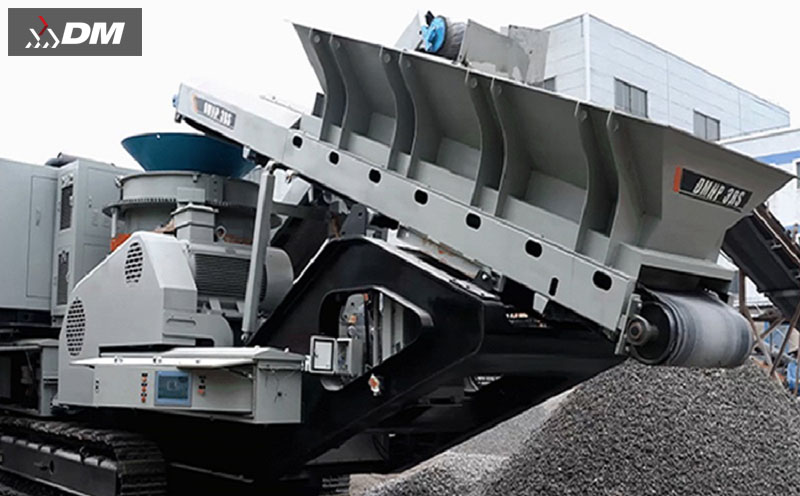
I. Threefold Pressure on Crushing Operations in Zambia: Practical Challenges of Energy Consumption, Cost and Compliance
Crushing links in Zambia's mineral development and infrastructure projects have long faced the dilemma of "high energy consumption, high maintenance and high risk": Remote mining areas rely on diesel power generation, with traditional crushers consuming 80-100L/h of fuel per unit, and energy costs accounting for over 35% of project operating expenses; Excessive dust emissions lead to harsh working environments, high rates of employee health complaints, and risks of environmental rectification; Equipment breakdowns occur frequently, with an average of 15-20 hours of unplanned downtime per month, and a single maintenance cost exceeding $5,000, directly affecting project progress.
A cobalt mine project was once ordered to suspend work for rectification due to substandard dust emissions, resulting in a $30,000 fine and a 20-day delay; Another infrastructure project, due to high energy consumption of traditional equipment, suffered daily losses of $20,000 when diesel transportation was blocked during the rainy season. These cases confirm that "low consumption, reliability and compliance" of crushing equipment have become a key prerequisite for the profitability of Zambian projects.
II. Three-in-One Solution: Technological Breakthroughs in Efficiency, Low Consumption and Compliance
New high-efficiency and low-consumption crushers target pain points in Zambian scenarios, building a full-link optimization system through power innovation, intelligent control and environmental upgrading:
1. Intelligent Switching of Dual Power, Significantly Reducing Energy Costs
Equipped with an oil-electric dual-power system, it can flexibly switch according to scenarios: Motor drive is enabled in grid-covered areas, reducing energy costs by 45% compared with diesel mode, with power consumption per unit controlled at 50-60 kWh per hour; In off-grid mining areas, when diesel power is used, the intelligent fuel-saving module automatically adjusts fuel supply through load sensing, reducing fuel consumption by 18-22% compared with traditional equipment. Application data from a copper mine shows that after adopting the dual-power mode, annual energy expenditure decreased from $120,000 to $70,000, a saving of 42%.
2. Intelligent Operation and Maintenance with Tough Design, Reducing Fault Downtime
Integrated with IoT sensors and a remote operation and maintenance platform, it real-time monitors 12 key parameters such as bearing temperature, hydraulic system pressure and liner wear. Through AI algorithms, potential faults are warned 72 hours in advance, reducing unplanned downtime by 80%. The core structure of the equipment is integrally cast with high-strength steel, improving fatigue resistance by 50%, with a mean time between failures (MTBF) of 1800 hours, 60% longer than traditional equipment. Wear parts adopt a modular design, reducing replacement time to less than 4 hours and improving maintenance efficiency by 50%.
3. Multi-Level Environmental Treatment, Ensuring Compliant Operation
Equipped with a three-stage dust removal system of "negative pressure dust suction + bag filtration + water mist dust suppression", the dust emission concentration is controlled at 3-5mg/m³, far lower than the general industry standard (10mg/m³), improving air quality in the operation area by 80%. Engine emissions meet Tier 3 standards, reducing nitrogen oxides and particulate emissions, and avoiding the risk of environmental penalties. After application in a mine in an ecologically sensitive area, it successfully passed environmental acceptance, saving $50,000/year in compliance costs compared with pre-rectification.
III. Practical Results: All-Dimensional Improvement from Cost Saving to Operational Upgrade
In 2023, a comprehensive project in Zambia (covering gold mining and supporting highway construction) introduced 4 new high-efficiency and low-consumption crushers, with remarkable results after 8 months of operation:
- Energy costs: The dual-power mode saved a total of $96,000 in diesel and electricity fees annually;
- Maintenance costs: Fault downtime reduced from 18 hours per month to 3.5 hours, cutting annual maintenance expenses by $62,000;
- Compliance costs: No environmental fines, saving $40,000/year in rectification expenses compared with surrounding projects;
- Comprehensive benefits: The comprehensive operating cost of equipment reduced by 40%, and the overall profit margin of the project increased by 8.5 percentage points.
The project engineer said: "The most intuitive change with the new equipment is that diesel barrel consumption has been halved, maintenance teams come less frequently, and there's no more tension during environmental inspections——all of which add up to real profits."
IV. Suggestions for Efficient Operation Adapting to Zambian Scenarios
To maximize equipment efficiency, combined with actual working conditions in Zambia, the following strategies are recommended:
- Power management: Use electric drive fixed in areas with stable power grids; In remote mining areas, schedule according to the mode of "diesel for peak load + battery energy storage for low load" to further reduce energy consumption;
- Maintenance planning: Use wear warning data from the intelligent platform to reserve wearing parts in advance, avoiding downtime caused by transportation delays during the rainy season;
- Environmental management: Clean dust removal bags regularly (every 15 days is recommended), and enable heating function in the rainy season to prevent filter bags from getting damp, ensuring stable dust removal efficiency.
Conclusion
Against the backdrop of rising operating costs and increasingly strict environmental requirements for Zambian projects, "high efficiency, low consumption and compliance" of crushing equipment is no longer a bonus, but a necessary capability for survival and development. The new crusher addresses core pain points of crushing operations in Zambia through a three-in-one solution of dual-power energy saving, intelligent operation and maintenance for cost reduction, and multi-level environmental compliance.
From reducing the consumption of each liter of diesel, to shortening each hour of downtime, to avoiding every compliance risk, this equipment is building a sustainable cost advantage for Zambia's mineral and infrastructure projects with a "cost-effective" operational logic, making "cost reduction" and "efficiency increase" no longer contradictory, and laying a solid foundation for long-term project profitability.
If you would like to get help immediately, you can also fill your requirements on the following form, we will contact you on the right time.


Get In Touch